The old world
Bird BoxThe old world is the life that existed before the Problem made ordinary perception dangerous. It persists not as a complete account of the past, but through recollections and contrasts: a cellar’s familiar fear, forbidden childhood pleasures, a stocked kitchen, a drink at a bar, and the expectation that childbirth would be attended by people who knew how to help. These memories reveal both what has been lost and how thoroughly survival has changed the meaning of care, freedom, and safety.
What the Old World Means
When Malorie arrives at the house, Felix explains that the residents stocked canned goods before the first reported incident in the Upper Peninsula. A storekeeper had thought the shoppers were crazy; now the provisions are expected to last about three months, though Don notes that the supply has diminished with Malorie’s arrival. The exchange places the old world at the edge of the new one: people could still prepare for ordinary needs, even as the first reports made such preparations seem strange. Food is no longer merely a household resource; its remaining quantity measures how many people the group can sustain.
The language of an “old-world fear” makes the change explicit. In an exchange about the cellar, Tom treats fear of it as a remnant carried over from the past. The cellar itself remains a place in the house, but its inherited associations belong to a world whose dangers and habits no longer define the present. The phrase marks a broader divide: fears once understood as ordinary or irrational have been displaced by the immediate threat of exposure to the creatures.
Freedom and Discipline
Malorie’s memories of childhood show the old world as a place where disobedience could be a source of pleasure. Her parents forbade sugar, scary movies, and sleeping on the living-room couch; she smuggled in sweets, crept downstairs at midnight to watch television, and moved her bed into the room anyway. Such small rebellions depended on a world in which a child could test boundaries without risking death. Against them, the children’s strict obedience is not simply good discipline. Malorie recognizes that it has been produced by fear so complete that they have never known the ordinary thrill of doing what they were told not to do.
That discipline began when the children were babies. Standing over their chicken-wire beds with a flyswatter, Malorie waited for them to wake and open their eyes. She struck their arms when they did, then closed their eyes with her fingers; if they kept their eyes shut, she lifted her shirt and fed them. The routine made protection inseparable from punishment and reward. The old world’s ordinary freedoms survive in Malorie’s memory precisely because her children’s upbringing has been organized around preventing a single forbidden act: looking.
Care, Motherhood, and Loss
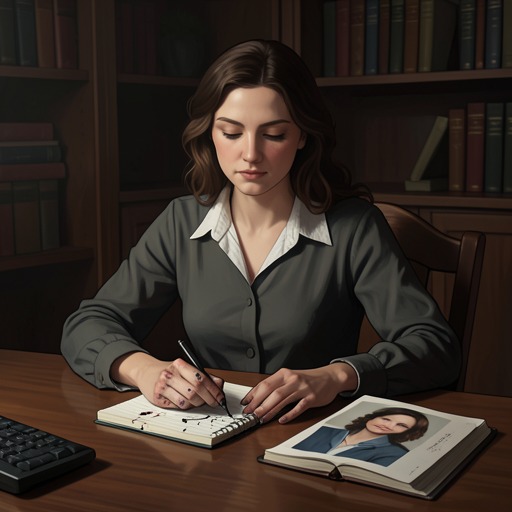
The old world also supplies Malorie with an image of what childbirth should have been. As her pregnancy advances, she reads books that discuss home delivery while warning about cleanliness and unforeseen complications. She imagines Shannon, her parents, friends, a reassuring nurse, fresh-smelling sheets, and flowers on a table. Experienced attendants, by behaving as though birth were easy, would have calmed her fear. The expected network of care is specific and social: it depends on people who can gather around a mother and help her through a dangerous bodily ordeal.
That expectation gives way to Malorie’s anticipation of labor as brute and inhuman, without a doctor or nurse. The contrast is not only between medical assistance and its absence. The old world offered an entire vocabulary of reassurance and shared experience; the new one leaves her to face childbirth under conditions that make the imagined support impossible. Her belief that women are bonded by the pain of childbirth persists even as the people who might have embodied that bond are missing.
The memory of Shannon also appears in a smaller, quieter gesture: Malorie pets a dog and thinks Shannon would have liked him. The thought preserves an intimate judgment of her sister within a changed life, while the surrounding house is defined by exhaustion, shock, and the need to ration food. Elsewhere, Malorie remembers that an afternoon at a bar could once feel wonderful: she drinks again and tries, for a moment, to forget the babies and the house. The drink offers a brief return to an old-world pleasure, but its escape is temporary; the dog is still tugging at the leash, and the demands of the present remain.
The Old World in the New
The past does not disappear when Malorie enters the survivor household. At one moment, after Gary’s influence has receded, Tom pours rum for himself and Don; they softly clink glasses and drink together. Malorie sees, briefly, a familiar possibility of the household as a community again. The scene makes the old world more than a vanished setting: gestures associated with ordinary fellowship can recur, even in a shelter shaped by fear and deprivation. Their return is fragile, however, and measured against the damage Gary’s presence and ideas have done to Don.
Malorie’s own response to danger is shaped by a knowledge that the old world could not fully prepare her for what survival might require. When Don proposes a course of action concerning the children’s eyes, Olympia regards it as insane and cruel, but Malorie understands the protective logic behind it. She imagines a future in which motherhood would be organized around guarding a child’s eyes and recognizes the dark possibility of making that burden disappear by extreme means. The suggestion remains in her mind even though the old world’s moral expectations offer no adequate preparation for it.
The old world is therefore both a store of human attachments and an inadequate guide to the rules of survival. In the present, Malorie organizes household work into concrete tasks—preparing dinner, emptying the waste bucket, improving the cellar, searching the yard for tools, feeding the birds, making calls, and washing bedding. She invokes the small comfort of cleaner sheets in a life where even washing has become scarce. Such work does not restore the former world, but it preserves habits of shared domestic care inside conditions that have stripped them of ease.
The sharpest measure of the divide comes when Malorie hears how the community at Tucker once survived. Rick explains that an earlier creature breach killed many people; in the aftermath, a mother who had been rational killed four children in a fit of rage. The community responded by blinding themselves with whatever they could find—forks, kitchen knives, even their fingers—because blindness offered what they understood as absolute protection. After a year, fortified security allowed them to abandon that burden, and Rick says there have been no security lapses since. Malorie thinks of George’s failed video experiments and of how close she came to blinding her own children. What had once seemed beyond the limits of imaginable motherhood belongs to the history of the new world. The old world matters because its memories keep those limits visible even as survival repeatedly tests them.